Geometry of Meaning was longlisted for the CBC Nonfiction Prize 2023 and selected as the semi-finalist of Shevchenko Foundation’s 2025 Emerging Writers Short Prose Competition. Here’s the full essay along with some photos of my grandmother’s rushnyks.
My grandmother’s rushnyk spreads out on the wall like wings of a colourful bird about to take flight. This six-foot long embroidered towel is a scroll of ancient tales, a map of memories from my childhood summers spent in a small village in the west of Ukraine. It is a verse in cross-stitch. I pore over familiar patterns, and as I pull on one thread, I find that it’s connected to all the other stories told in neatly arranged squares, triangles and rhombuses.

XXX
I am five or six and my grandmother is teaching me to pray. My age is just a guess here but I am definitely younger than seven because I haven’t started school yet. I dutifully repeat “Отче наш, що єси на небесах!” but my mind keeps wandering off as I try to decode the patterns on the rushnyk that frames the icon of Jesus.
All pictures in the house are draped in long towels arranged in tent-like shapes, their ends with multi-coloured embroidery fanned out on the wall. Pussy willow bows are tucked behind them on Easter, followed by lush linden branches for the Holy Trinity Sunday, often referred to as Green Holidays. Then come flowers for John the Baptist day, more commonly known by its pre-Christian name – Ivana Kupala feast – celebrated right around the summer solstice. On Christmas, a sheaf of wheat, called Didukh or Grandfather’s Spirit, is brought into the house and put under the icons, rushnyk’s long arms wrapped around it in a protective hug.
The spirit of the land is woven into every aspect of life, like the ancient patterns I am tracing right now.
“Нехай святиться ім’я Твоє,” I taste unfamiliar words in my mouth and shift my gaze to a matching towel on the other side of the wall framing the image of Mary. Each room has a set of those: Mary on the right, Jesus on the left, rushnyks around them mirroring each other. “Нехай прийде Царство Твоє,” I echo my grandmother as I switch to patterns on a tablecloth, curtains, pillows and cushions hoisted upright on the bed. My childhood mind collects the shapes, mixes them together and produces flowers that grow along the edges of the garden, a path that cuts through the field behind the house, an ice-cold meandering stream lined with fragrant mint, a forest that envelopes the village in a calming hug.
Despite my mental wanderings that day, the prayer gets lodged in my mind. When I go back to kindergarten in the fall, I recite it from beginning to end in front of a portrait of Lenin, a staple in every institution. It is the eighties. The collapse of the Soviet Union is ten years in the future. Religion, if not outright prohibited, is frowned upon. My parents receive a warning. My religiosity undergoes many permutations over the years but doesn’t stick. Connection to the land and belief in protective powers of my grandmother’s rushnyk do.
XXX
Rushnyks in Ukraine have been part of every religious, community or family event for centuries. They bracket a person’s life – used during christening to swaddle the baby and at a funeral to cover the deceased. At a wedding ceremony, a couple steps on a rushnyk to recite their vows and then their hands are bound together with another one as a symbol of unity. Special guests at big celebrations are welcomed with a kolach, an elaborate round bread, and salt on top of an embroidered towel.

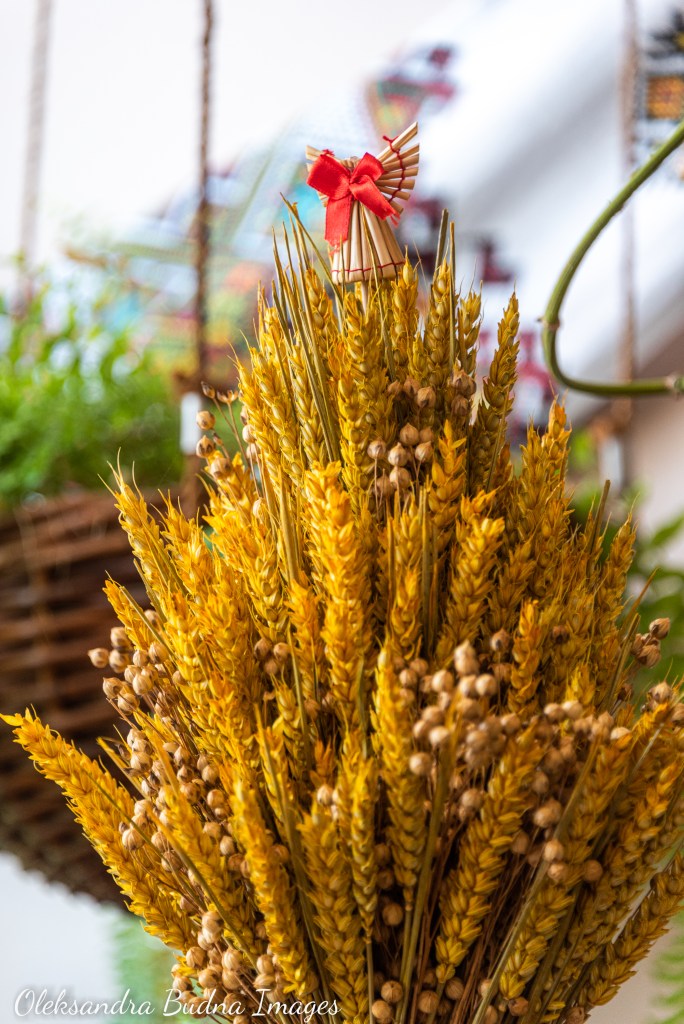
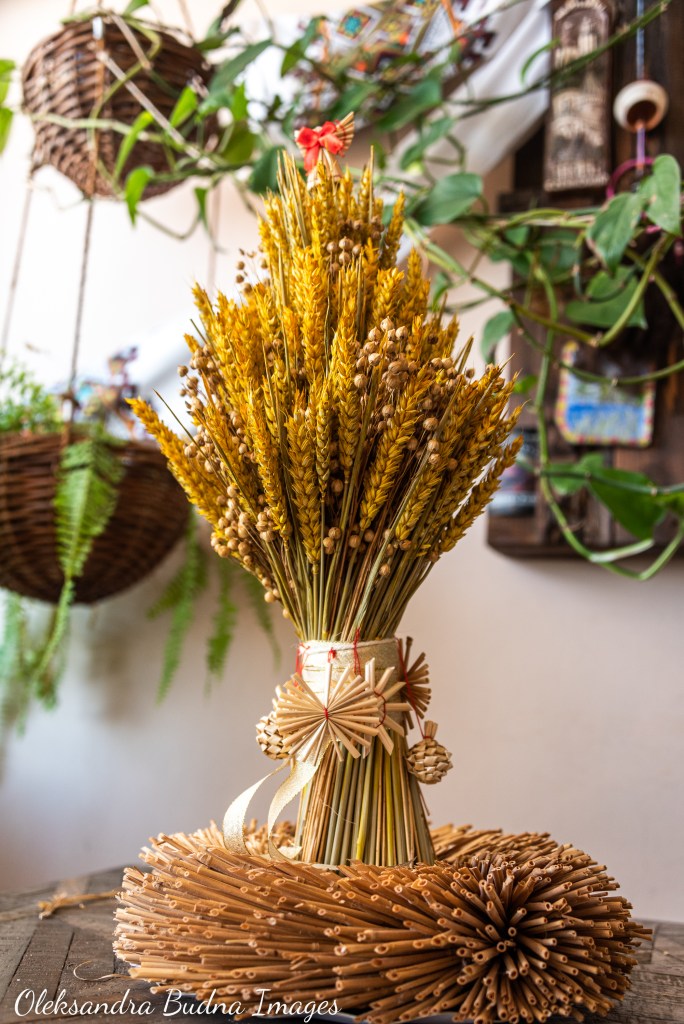
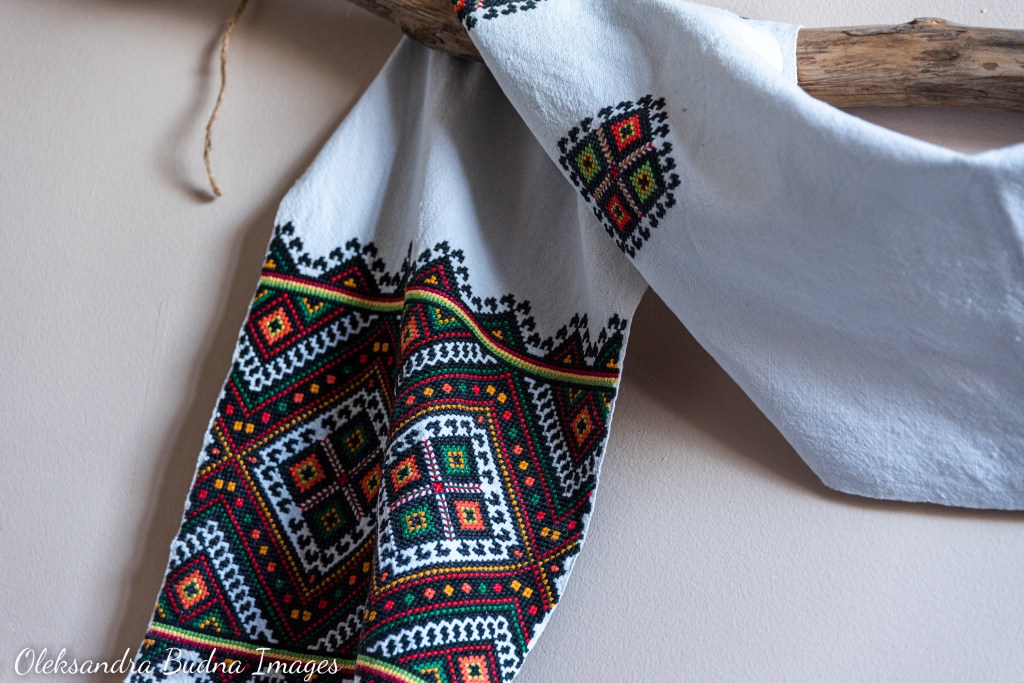

Rushnyks have also been part of various rituals and celebrations – decorating an ice cross on Epiphany and a birch tree on the Feast of the Trinity. The last sheaf of grain gathered during the harvest festival is often tied with a rushnyk. When a house is constructed, the final beam is hoisted into place with rushnyks, which are then given to the workmen as gifts. Rushnyks that are hung in the house are believed to possess special powers – they serve as a protective charm and a link between the living and the dead.
XXX
It’s a hot August day of 2022, and I am in the car with my mother and my uncle on the way to my grandparents’ village. The war is raging in Ukraine but here, under the protective spell of my grandparents’ house, its raucous is distant, like something from a different timeline. My grandmother has been dead for almost 20 years, my grandfather for four. Their house is empty and locked, an echo chamber of memories; the paint on doors and windowpanes is cracked and wrinkled. I wander through an overgrown field behind their house in hopes to get to the forest, but the trail is impassable. The stream is no more than a faint whisper muffled by waist-high grasses. I close my eyes and get lost in the memories. I inhale the aroma of baked bread right out of the clay oven that used to sit by the stream. I smell freshly cut wood in my grandfather’s workshop. I catch a whiff of my grandmother’s flowers: peonies, rolled up in tiny balls ready to explode into an unruly mass of fragrant joy, dahlias with their neatly arranged spirals of petals, and, of course, orange-eyed marigolds, my grandmother’s favourite.
I pack these smells along with my grandmother’s rusknyk and bring them back with me.
As I put it up on the wall in our apartment in Toronto, a memory emerges of my grandmother teaching me embroidery. She lets me pick a colour; after perusing the floss coiled up in bright piles on the table, I go for red. I help her thread the needle; she shows me how to make a row of neat diagonal stitches from left to right, then trace back to the beginning of the row with overlapping stitches in the other direction. I watch her hands move quickly across the canvas, filling its blankness with meaning. After a few rows, she passes it to me. My progress is slow – stitch after parallel stitch, turn back, cross over, repeat, another row, another colour – but, eventually, after a few miscalculations and do-overs, shapes and patterns start to emerge. That summer, fascinated by the discovery that I possess this magic at my fingertips, I carry my embroidery with me at all times, using every opportunity to add a few more stitches. By the time September rolls in, I finish a square napkin with red and black triangles all around its border.
Similar triangles line the edges of the rushnyk on my wall. I trace these patterns, just like I did when I was five or six, in between “Нехай буде воля Твоя” and “Як на небі, так і на землі.” I listen to them in an attempt to detect if they tell stories of special occasions and celebrations or whisper of everyday happenings, no less memorable in their ordinariness. The colours are still vibrant but I notice that some parts of the rushnyk are fraying along the edges. I think of the land where I grew up getting obliterated as missiles rain from the sky. I am worried that my memories – those threads that connect me not only to my grandparents but also to my home country – will eventually fade away too, irretrievably lost under the barrage of images of destruction and death that have defined Ukraine over the last two years. So I go over those memories again and again: stitch after parallel stitch, turn back, cross over, repeat, row after colourful row.
XXX
Around 200 types of stiches are used in the Ukrainian embroidery with distinct regional differences in thread colours and themes. Multi-coloured geometric patterns are featured in the western parts of the country. Floral designs, usually done in one or two colours, are more popular in eastern and central Ukraine. Stylized animals and birds appear on rushnyks made in the south and south-west. Motifs and colours reflect the world around, yet every shape also carries a deeper meaning, a recording of ancestral memory connected to ancient patterns common to many cultures across the world. A circle symbolizes the sun and life-giving energy. A square means the land, while a rhombus is a symbol of fertility, good harvest and prosperity. A triangle represents the three elements: water, air and fire, as well as the unity of the three worlds: the Earth, underworld and heavens. Spirals and zigzags mean water, infinity and the passage of time. The tree of life, with its parts representing the past, present and future, symbolizes family and, therefore, often appears on rushnyks used in a wedding ceremony.


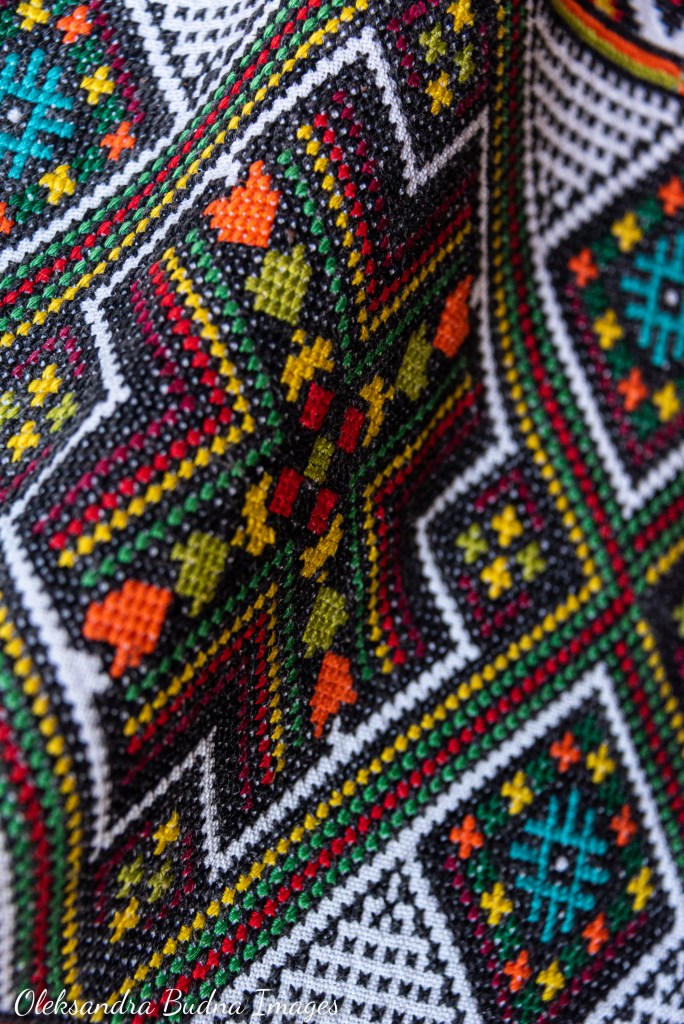

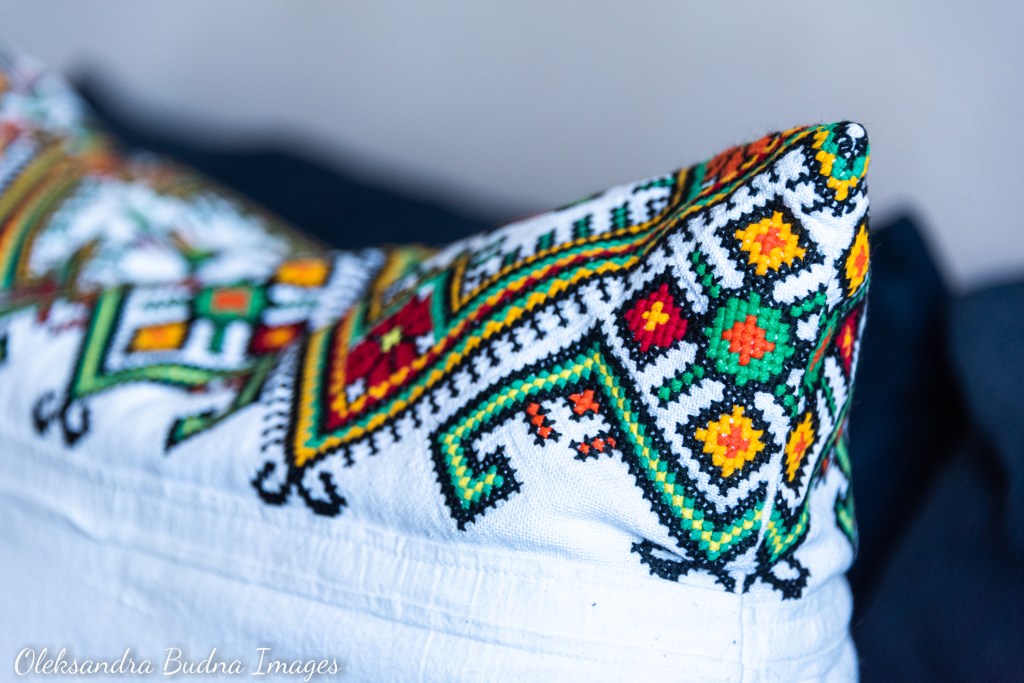
In the past, embroidery was more than a craft. It was a ritual that had to be performed on special days with bright thoughts and positive energy. Embroiderers didn’t copy patterns but created their own. Using ancestral symbols they encoded their stories, as well as desires and wishes for themselves and their families. With their ability to both reflect the reality and call it into being, rushnyks serve as living anthologies that tell of the past and future at the same time.
XXX
I study my grandmother’s rushnyk trying to decipher what visions of the future she embroidered into it. Did they include me moving to another country? Is that what the two ends of the towel represent: the land that shaped and nurtured me and the land where I have lived for the past twenty years – almost half of my life by now? I take in the blank unembroidered space between the two ends, the ocean that both separates and connects those two lands. I wonder if this is the space I am bound to inhabit from now on as I struggle to reconcile the gap between my home country resisting yet another colonization attempt by Russia and the Indigenous land that we now call Canada where I get to enjoy a peaceful life as a settler. Or do I get to fill this space with my own patterns even if I don’t have all the answers?
Then it occurs to me that a rushnyk may be more than a record of memories and hopes. Along ancient tales and future dreams, these entangled patterns spell out questions that I must live every day – making my own meaning, honouring the stories that I hold within me, and giving voice to new narratives born at the intersection of history and imagination. Stitch after parallel stitch, over and over again, until I pass this embroidered scroll on to my children.
 Stories of Entangled Life
Beautifully written as always! I loved learning about the different meanings behind the various patterns!
LikeLiked by 1 person
Thank you ❤
LikeLike